Dividing a range
An analog-to-digital converter assigns an input to one of a finite set of numerical codes. Its bit count tells us how many codes are available: each additional bit doubles the number. The selected input range matters too, because the same number of codes can be spread over a wider or narrower interval.
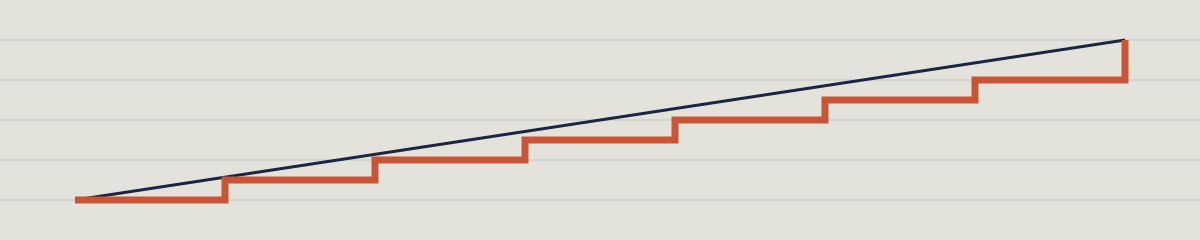
Consider a hypothetical ideal eight-bit converter covering a range of 4 volts. It has 256 possible codes, giving a nominal code width of 4 divided by 256, or 0.015625 volt. That calculation describes the spacing of ideal levels. It is not a guarantee that every measured value is within that distance of the actual input.
Fine increments, uncertain values
Resolution concerns the size of distinguishable increments. Accuracy concerns closeness to the actual value. A persistent offset can move readings away from the true input even when the output changes in very fine steps. Gain error can change the scale, while noise causes readings to vary.
The converter is also only part of a measurement chain. Input circuitry, signal conditioning and temperature can affect the result. A larger nominal bit count does not remove these influences. Input noise specifications help explain why the smallest useful change in a real measurement can differ from an ideal calculation of code spacing.
Give the number its setting
Before comparing two specifications, check that their input ranges, signal frequencies and operating conditions match. A figure stated for one setting should not silently become a promise for another. The number of decimal places on a screen is especially easy to confuse with dependable information.
For a useful record, keep the value, unit, selected range and relevant conditions together. If a calculation displays extra digits, ask whether those digits reflect the underlying measurement or merely the arithmetic used to display it. This is a reading habit, not a substitute for a device specification or a full uncertainty assessment.
The central distinction is simple: more available steps offer a finer language for representing an input. Confidence in what those steps mean still depends on the complete measurement system.